The Large Hadron Collider (LHC), a 27 kilometer (17 mile) long particle accelerator straddling the border of Switzerland and France, is nearly set to begin its first particle beam tests. The European Organization for Nuclear Research (CERN) is preparing for its first small tests in early August, leading to a planned full-track test in September - and the first planned particle collisions before the end of the year. The final step before starting is the chilling of the entire collider to -271.25 C (-456.25 F). Here is a collection of photographs from CERN, showing various stages of completion of the LHC and several of its larger experiments (some over seven stories tall), over the past several years
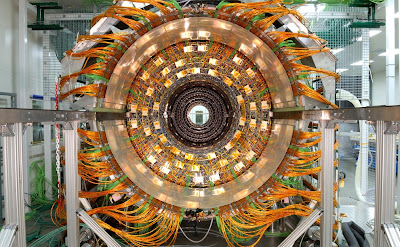
View of the CMS (Compact Muon Solenoid) experiment Tracker Outer Barrel (TOB) in the cleaning room. The CMS is one of two general-purpose LHC experiments designed to explore the physics of the Terascale, the energy region where physicists believe they will find answers to the central questions at the heart of 21st-century particle physics. (Maximilien Brice, © CERN)
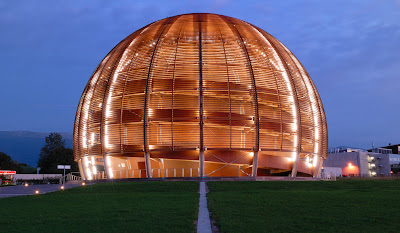
The Globe of Innovation in the morning. The wooden globe is a structure originally built for Switzerland’s national exhibition, Expo’02, and is 40 meters wide, 27 meters tall. (Maximilien Brice; Claudia Marcelloni, © CERN)

Assembly and installation of the ATLAS Hadronic endcap Liquid Argon Calorimeter. The ATLAS detector contains a series of ever-larger concentric cylinders around the central interaction point where the LHC’s proton beams collide. (Roy Langstaff, © CERN)

Checks are performed on the alignment of the magnets in the LHC tunnel. It is vital that each magnet is placed exactly where it has been designed so that the path of the beam is precisely controlled. (Maximilien Brice, © CERN

The ALICE Inner Tracking System during its transport in the experimental cavern and its insertion into the Time Projection Chamber (TPC). ALICE (A Large Ion Collider Experiment @ CERN) will study the physics of ultrahigh-energy proton-proton and lead-lead collisions and will explore conditions in the first instants of the universe, a few microseconds after the Big Bang. (Maximilien Brice, © CERN)
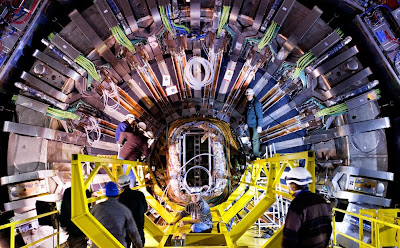
Insertion of the tracker in the heart of the CMS detector. (Maximilien Brice, © CERN)

The LHCb electromagnetic calorimeter. This huge 6X7 square meter wall consists of 3300 blocks containing scintillator, fibre optics and lead. It will measure the energy of particles produced in proton-proton collisions at the LHC when it is started. Photons, electrons and positrons will pass through the layers of material in these modules and deposit their energy in the detector through a shower of particles. (Maximilien Brice, © CERN)

Photo from the CMS pixel-strip integration test performed at the Tracker Integration Facility at the Meyrin site. (Maximilien Brice, © CERN)

French, Swiss and CERN firemen move rescue equipment through the LHC tunnel. (Maximilien Brice, © CERN)

View of the LHC cryo-magnet inside the tunnel. (Maximilien Brice, © CERN)
 Insertion of the tracker in the heart of the CMS detector. (Maximilien Brice, © CERN)

The Z+ end of the CMS Tracker with Tracker Outer Barrel completed. (Maximilien Brice, © CERN)

View from the surface during lowering of the first ATLAS small wheel into the tunnel on side C of the cavern. (Claudia Marcelloni, © CERN)

Lowering of one of the two ATLAS muon small wheels into the cavern. (Claudia Marcelloni, © CERN)

A welder works on the interconnection between two of the LHC’s superconducting magnet systems, in the LHC tunnel. (Maximilien Brice, © CERN)
 Transporting the ATLAS Magnet Toroid End-Cap A between building 180 to ATLAS point 1. (Claudia Marcelloni, © CERN)

View of the ATLAS cavern side A beginning of February 2008, before lowering of the Muon Small Wheels (Maximilien Brice; Claudia Marcelloni, © CERN)

The L3 magnet in the ALICE cavern, with one door almost closed. (Mona Schweizer, © CERN)

Lowering of the last element (YE-1) of the CMS detector into its underground experimental cavern. (Mona Schweizer, © CERN)

The first ATLAS Inner Detector End-Cap after complete insertion within the Liquid Argon Cryostat. (Claudia Marcelloni; Max Brice, © CERN)


 Posts
Posts

